Guide · Surgical
Surgical scissors: types and uses
Surgical scissors look similar but are made for different jobs. Here is how to read the names, choose the right pair for the task, and avoid damaging the blades.
General information, not medical or veterinary advice. Follow your local rules and the instructions that come with your equipment.
How scissors are described
Catalogue names combine four features: the pattern name, the blade shape, the tip style and the length. Learning these four features makes any scissors listing easier to read.
- Straight or curved. Straight blades suit cutting sutures and working in a line. Curved blades follow tissue planes and let you see the tips while cutting.
- Tip style. Sharp/sharp has two pointed tips. Sharp/blunt has one of each. Blunt/blunt has two rounded tips, which lowers the chance of nicking tissue that sits beside the cut.
- Blade edge. Smooth blades give a clean cut. Serrated or micro-serrated blades grip slippery tissue or fabric so it does not slide away.
- Length. Longer scissors reach deeper. Shorter ones give more control near the surface.
Common patterns and what they do
| Pattern | Typical use | Notes |
|---|---|---|
| Metzenbaum | Fine dissection of delicate tissue | Long handles, slim blades. Keep for tissue, not for sutures. |
| Mayo | Heavier tissue, and cutting sutures | Strong, thick blades. Straight Mayo is the usual choice for sutures. |
| Iris | Small, precise cuts in delicate tissue | Short and fine. Easy to damage if used on tough material. |
| Suture scissors | Cutting sutures and ligatures | A dedicated pair protects your tissue scissors from dulling. |
| Lister bandage scissors | Cutting dressings and bandages | An angled blade with a blunt lower tip that slides under the bandage without catching the skin. |
Dental and oral surgery trays often add scissors shaped for soft tissue in the mouth, such as small curved, serrated types used for gum tissue. Names vary between makers, so ask for a photo or drawing before you order a pattern you have not used before.
Choosing the right pair for the job
- Write down the task first: dissect tissue, cut sutures, trim gum tissue, or cut dressings.
- Pick the tip style that matches the risk. Use blunt tips near tissue you want to protect.
- Match the length to the depth of the field and to your hand.
- Choose smooth or serrated blades according to how slippery the material is.
- Keep separate scissors for separate jobs. Using tissue scissors on sutures, gauze or tape dulls the edge quickly.
Standard steel and carbide inserts
Most reusable scissors are made from martensitic stainless steel, hardened so the edge stays sharp. Some catalogues offer tungsten carbide inserts in the blades. They keep an edge longer and usually cost more. A gold-coloured handle is the usual signal that a pair has carbide inserts. See our notes on AISI 410 and 420 stainless steel for how the base steel is chosen and treated.
Checking a pair before you use it
- Open and close the blades. The motion should be smooth with no grinding or play at the screw.
- Look at the tips from above. They should meet exactly.
- Cut a single layer of thin material near the tips and again near the screw. A good pair cuts cleanly along the whole blade.
- Check the screw. A loose screw lets the blades separate and chew the material.
Care and sharpening
Rinse scissors soon after use and clean them with the blades open so debris does not stay in the joint. Dry them fully, apply a steam-permeable instrument lubricant to the screw, and sterilize with the blades unlocked and slightly open. Do not drop them, and do not use them to cut wire or anything they were not made for. When the cut starts to drag, have them sharpened by someone who works on surgical scissors, since the edge angle must be kept. A care checklist covers the rest of the routine.
Where to find them at E74
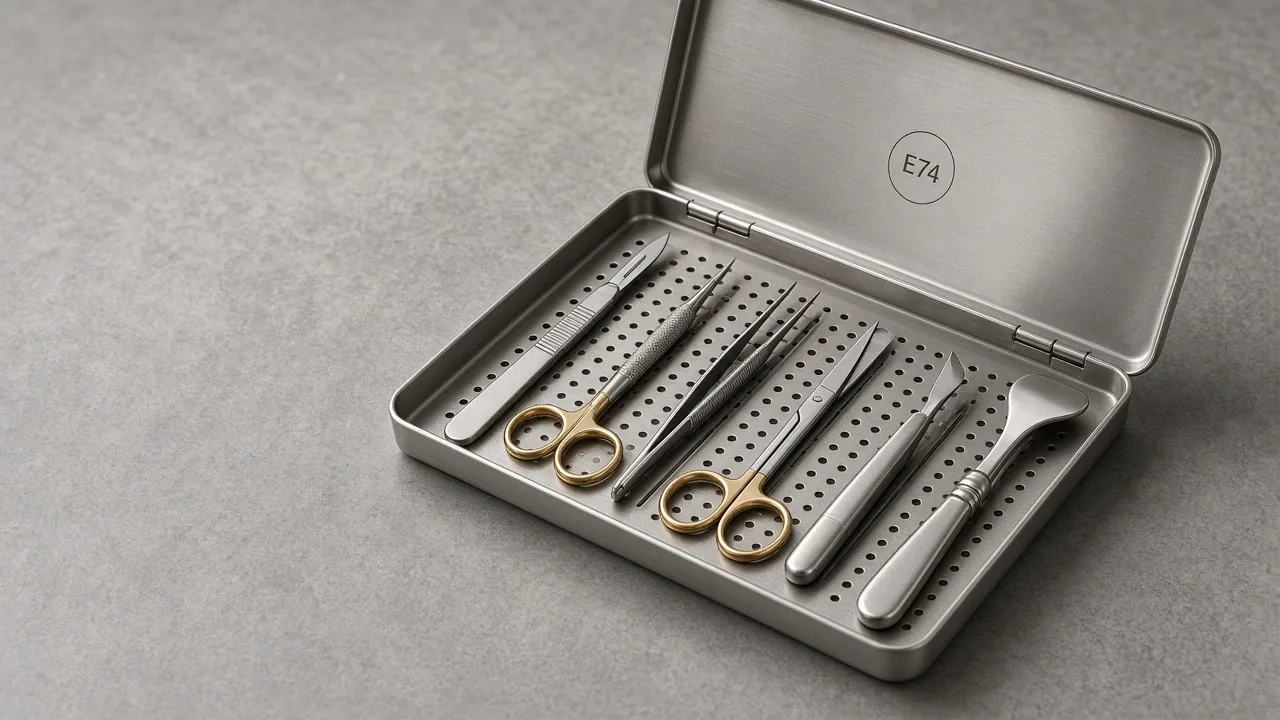
Scissors are part of our Oral Surgery Kit, which also holds elevators, periotomes, forceps, a needle holder and retractors in a sterilization cassette. For animal care we list Lister bandage scissors and grooming scissor sets, which are price on request through the contact form.
Related products
Questions
What is the difference between Metzenbaum and Mayo scissors?
Metzenbaum scissors have slimmer blades and longer handles for delicate tissue. Mayo scissors are heavier and stronger, and straight Mayo scissors are often used to cut sutures.
What do blunt and sharp tips mean?
They describe the tip of each blade. Blunt tips are rounded to reduce the chance of cutting tissue by accident. Sharp tips are pointed for fine work. Many scissors combine one of each.
Can I use tissue scissors to cut sutures?
You can, but it dulls the blades quickly. Most clinicians keep a separate pair for sutures so the tissue scissors stay sharp.
What are Lister bandage scissors?
Scissors with an angled blade and a blunt lower tip. The blunt tip slides under a bandage or dressing so you can cut it without catching the skin.
How do I know when scissors need sharpening?
When they drag, fold the material instead of cutting it, or leave a ragged edge along the blade. Have them sharpened before you replace them.